
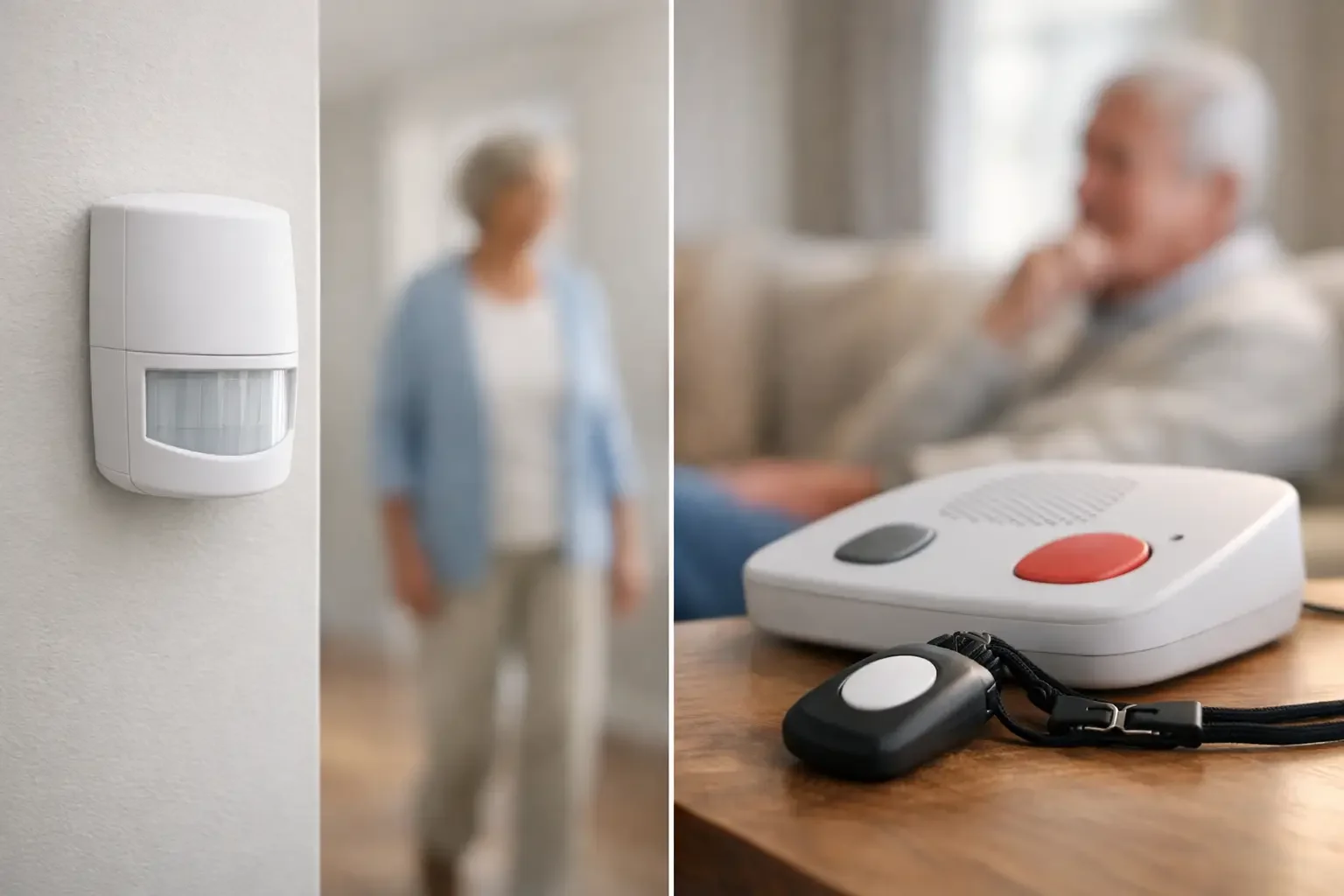
For many families, both options sound reassuring at first. A medical alert system promises fast help in an emergency. Motion sensors promise visibility into what is happening at home. The challenge is that they solve different problems, and choosing between them depends on the kind of risk you are trying to reduce.
Motion sensors versus medical alert systems: the core difference
A medical alert system is built around a direct call for help. In most cases, the older adult wears a pendant or wrist button and presses it when they need assistance. Some systems also include automatic fall detection, but the main idea is still the same: the person at home has to wear the device and, often, activate it.
Motion sensors work differently. They are placed around the home and track movement patterns passively. Instead of waiting for someone to push a button, they notice activity - or the lack of it. That could mean recognizing that your dad never got out of bed at his usual time, that he has been making more frequent bathroom trips overnight, or that there has been no movement in the kitchen all morning.
This is why the comparison can feel confusing. Medical alert systems are event-based. Motion sensors are pattern-based. One is designed for a moment of crisis. The other is designed to catch the early signs that something may be off before a crisis happens.
Where medical alert systems work well
There is a reason medical alert systems have been around for so long. In the right situation, they are straightforward and useful. If an older adult falls, feels chest pain, or becomes dizzy and can still press a button, they can quickly connect with emergency support or a caregiver.
That simplicity matters. Some seniors like knowing they have a clear, immediate way to call for help. Families often find comfort in that too, especially when a parent lives alone.
Medical alert systems can be a strong fit for seniors who are cognitively sharp, willing to wear the device consistently, and likely to remember to use it under stress. They can also make sense for someone who wants a visible, familiar safety tool and is comfortable with the idea of asking for help in the moment.
But there are trade-offs. A wearable only works if it is being worn. A button only helps if the person can reach it, remembers it, and is physically able to press it. That sounds obvious, but it is the gap many families discover too late. After a fall or medical event, a loved one may be disoriented, unconscious, or simply embarrassed and hesitant to call.
Where motion sensors work well
Motion sensors are often a better fit when the family’s biggest concern is uncertainty. You may not be worried about one dramatic event as much as a slow change you cannot see from across town. Maybe your mom is recovering from a hospitalization. Maybe your dad has Parkinson’s. Maybe your parent insists they are fine, but your gut tells you something is changing.
Passive monitoring helps in those situations because it does not depend on memory, behavior, or compliance. The system quietly learns what is normal and flags meaningful changes. That could include less movement during the day, more time in the bathroom, missed meals, disrupted sleep, or an unusual stretch of inactivity.
For caregivers, this kind of information can reduce the hardest part of supporting an aging parent: not knowing. Instead of wondering whether no news is good news, you get signals that help you decide when to check in.
Just as important, motion sensors are usually more privacy-friendly than cameras or microphones. They do not record conversations or video. For seniors who value dignity and do not want to feel watched, that can make a big difference in whether they accept help at all.
The limits of each system
Neither option is perfect, and that matters.
A medical alert system does not tell you much about everyday well-being. If your parent is moving less, sleeping poorly, skipping meals, or starting to struggle with normal routines, the device may never flag it. It may sit quietly until there is a major event.
Motion sensors, on the other hand, are not a replacement for emergency response in every situation. They can identify unusual inactivity or a pattern shift, but they do not always provide the same direct, one-button connection to urgent help that a traditional medical alert system offers.
This is why families sometimes ask the wrong question. It is not always which system is better. It is which problem are you trying to solve first.
If your main worry is, "What if she falls and can still call for help?" a medical alert system may cover that need. If your bigger worry is, "What if something starts changing and no one notices for days or weeks?" motion sensors may be the stronger choice.
When motion sensors versus medical alert systems is not either-or
For some households, the best answer is both.
That is especially true when an older adult has multiple risks. Someone with mobility issues may benefit from a wearable alert button for emergencies, while passive motion monitoring helps the family watch for changes in recovery, sleep, or daily routines. The two systems can support different layers of care.
Still, many families prefer to start with the option that places less burden on the senior. That is one reason passive monitoring has gained attention. It works in the background. There is nothing to charge, remember, or press. For older adults who resist "looking frail" or dislike wearing devices, that can remove a major barrier.
In real life, adoption matters as much as features. A perfect system that your parent refuses to use is not perfect at all.
What family caregivers should ask before choosing
Before you compare brands or pricing, take a step back and think about your loved one’s daily life.
Are they likely to wear a pendant every day, including in the shower or at night? If not, a medical alert system may leave important gaps. Are they dealing with memory issues, balance changes, or a condition that can affect judgment or reaction time? If so, relying on them to call for help may not be enough.
Then ask what kind of visibility would actually bring you peace of mind. Some caregivers want a direct emergency tool. Others want reassurance that a parent is up, moving, sleeping, and following familiar routines. If you are constantly texting, calling neighbors, or wondering whether you should intervene, passive monitoring may solve the deeper problem.
It is also worth considering your loved one’s personality. Many seniors reject anything that feels stigmatizing or invasive. A discreet in-home system can feel more respectful than a camera in the living room or a device they are expected to wear like a warning label.
A more realistic way to think about safety at home
Safety is not only about what happens during an emergency. It is also about the small warning signs beforehand.
A parent may not press a button because they do not think the situation is serious enough. They may not want to bother anyone. They may be asleep, confused, or unable to respond. On the other side, a passive system may show that something has been changing for days: later wake times, less kitchen activity, restless nights, or more bathroom visits. Those details can help families step in earlier, before a bad day becomes a crisis.
That is where newer approaches to in-home monitoring can be especially helpful. Systems like StackCare build on simple motion sensors by adding behavioral intelligence, so families are not left interpreting raw activity on their own. Instead, they receive clearer alerts and summaries that make the information usable.
For caregivers already carrying work, parenting, and the emotional weight of supporting an aging parent, that clarity matters. You do not need more data. You need to know when something changed and whether it is time to pay attention.
The best technology is the one that fits your loved one’s habits, respects their dignity, and helps your family act sooner with less guesswork. If you are weighing motion sensors versus medical alert systems, start there. The right choice is not the one with the longest feature list. It is the one your family will trust, your loved one will accept, and your daily life will feel lighter using.