
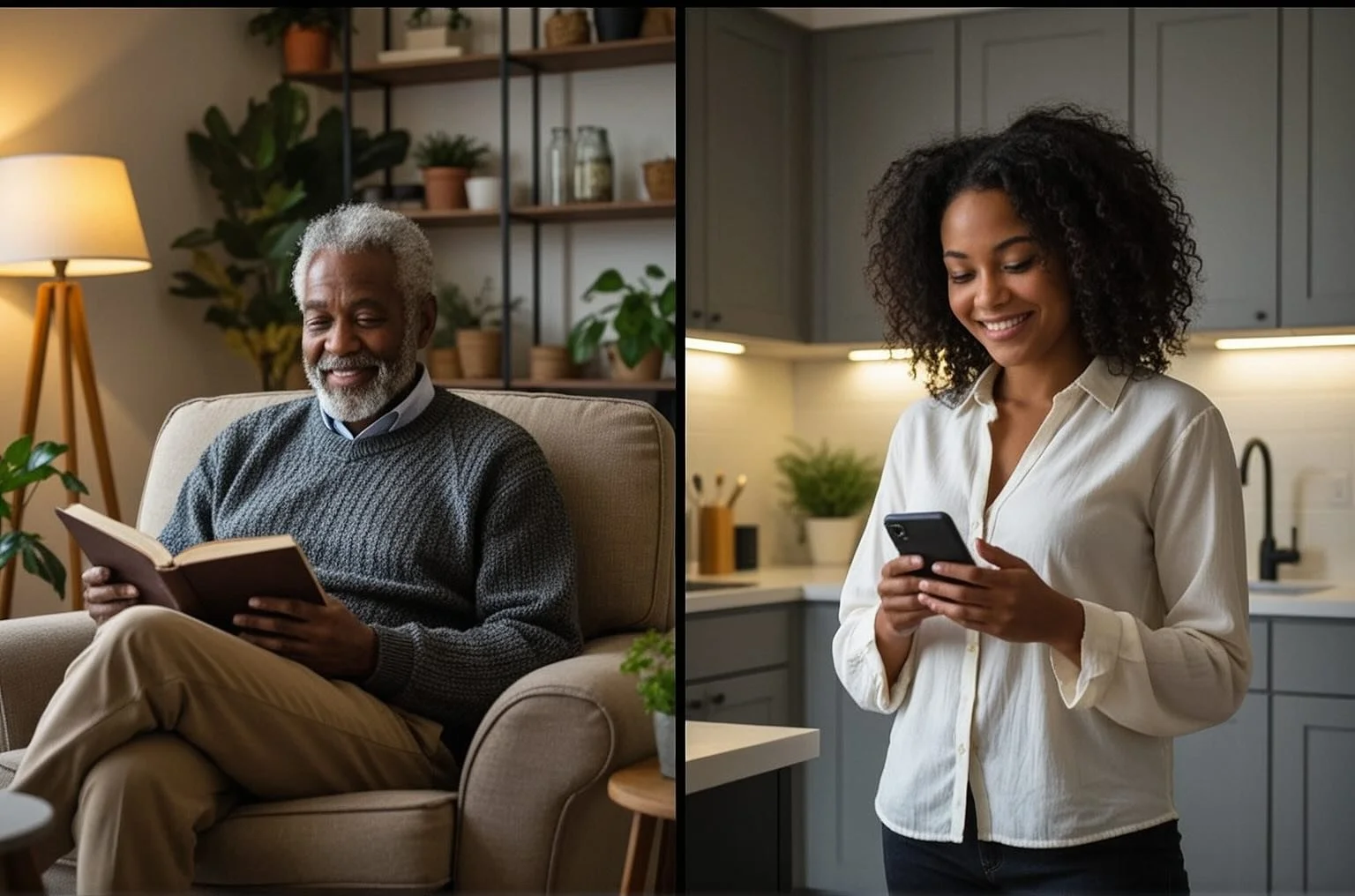
For adult children caring from across town or across the country, uncertainty is often the hardest part. If Mom does not answer the phone, is she napping, out with a friend, or lying on the floor after a fall? If Dad seems a little more forgetful lately, is it just a rough week or the start of a pattern? Passive monitoring does not replace human care, but it can reduce the guesswork that turns normal concern into constant worry.
What passive monitoring actually means
Passive monitoring is a way to keep track of daily activity in the home without asking an older adult to wear a device, press buttons, or live under a camera. Instead, small motion sensors placed around the home detect movement and help build a picture of normal routines over time.
That picture matters more than a single moment. One missed phone call may mean nothing. But if someone who usually wakes up at 7:00 has no bedroom activity by 10:00, or starts making frequent overnight bathroom trips, those changes can tell a family something important may be shifting.
The best passive monitoring systems do more than collect motion data. They interpret patterns and send simple alerts or summaries so family caregivers are not forced to study raw activity logs. That difference is easy to overlook, but it is often what makes the technology useful in real life.
Why families are turning to passive monitoring
Most families do not start looking for support because of a single dramatic event. More often, it begins with a series of smaller moments. A parent forgets to charge their phone. A neighbor mentions they have not seen them outside in a few days. You notice they seem slower getting around, but you are not sure whether it is meaningful.
At the same time, many older adults are clear about what they do not want. They do not want a camera in the living room. They do not want to wear a watch they forget to charge. They do not want to feel supervised in their own home.
Passive monitoring sits in the middle of those two realities. It gives families visibility without making the older adult feel watched. That balance is why it is especially helpful for seniors who live alone, want to remain independent, and need a little more oversight than occasional check-ins can provide.
A family guide to passive monitoring starts with the right goal
Before comparing features, it helps to be honest about what problem you are trying to solve. Some families are worried about falls. Others are noticing signs of cognitive decline, recovery after hospitalization, or changes linked to Parkinson’s disease or reduced mobility. Some simply want reassurance that a parent is up, moving, and keeping a predictable routine.
Those are not all the same need, and the right setup depends on the answer. If your main concern is general wellbeing, activity trends and daily summaries may be enough. If your concern is sudden change, real-time alerts become more important. If you are supporting someone who gets up often at night, bathroom and bedroom activity may matter more than front-door movement.
A good system should help you see what is relevant without flooding you with information. More data is not always more helpful. For a family already stretched thin, clarity matters more.
What passive monitoring can help you notice
When passive monitoring works well, it highlights changes in routine that might otherwise go unnoticed for days or weeks. That can include less movement during the day, long periods of inactivity, unusual overnight wandering, or a shift in bathroom habits.
These are not diagnoses. They are signals. A drop in kitchen activity could mean a parent is skipping meals, feeling unwell, or just having a quieter day than usual. More nighttime motion could reflect poor sleep, medication changes, urinary issues, or increased confusion.
That is the trade-off families should understand. Passive monitoring is powerful because it gives context and continuity, but it does not tell you everything. It will not explain why something changed on its own. It helps you know when to ask better questions, check in sooner, or involve a doctor if needed.
Privacy is not a side benefit
For many families, privacy is the deciding factor. A solution can be technically impressive and still feel wrong if it turns a home into a place of surveillance.
That is why passive monitoring appeals to so many older adults. There are no cameras recording personal moments. No microphones capturing conversations. No expectation that someone must remember to wear or charge a device every day. The home stays a home.
This matters emotionally as much as practically. Seniors are more likely to accept support when it does not feel intrusive or infantilizing. Adult children are more likely to stick with a system when they feel informed rather than voyeuristic. Good caregiving support should reduce tension, not create new arguments about privacy and control.
What to look for in a family guide to passive monitoring solutions
Not all systems are built the same, even if they sound similar on the surface. Some give you streams of sensor activity and leave interpretation up to you. Others use behavioral analytics to learn routine patterns and turn them into plain-language insights.
That distinction matters when you are juggling work, kids, appointments, and your own life. You should not have to become a data analyst to know whether your parent seems okay.
Look for a system that makes setup straightforward, communicates clearly, and sends alerts that are specific enough to be useful. “No activity detected this morning” tells you more than a vague warning. Daily summaries can also be valuable because they reduce the need to check the app constantly while still keeping you informed.
It also helps to ask how the system handles normal variation. No one follows the exact same routine every day. Good monitoring should recognize patterns over time, not treat every small difference as a crisis. Too many false alarms can cause families to ignore alerts altogether.
How to introduce passive monitoring to a parent
This conversation often goes better when the goal is framed around support, not control. Most older adults respond poorly if they feel the decision has already been made for them. They respond much better when they hear what the system is meant to protect.
It can help to say, “I know you want to stay in your home, and I want that too. This would help me know if something changes without bothering you all day.” That keeps the focus where it belongs - on independence, safety, and peace of mind.
Be prepared for mixed feelings. A parent may agree with the logic and still feel uneasy at first. That does not always mean the answer is no. It may mean they need reassurance about privacy, what is and is not being tracked, and who will see the information.
The best conversations are concrete. Explain that the system notices movement, not personal details. Explain that it helps spot changes in routine, not monitor every choice. And explain that the point is to support living at home longer, not to take autonomy away.
When passive monitoring is especially useful
Passive monitoring is often a strong fit after a hospitalization, during recovery from injury, or when a family is noticing subtle declines but is not ready for in-home care every day. It can also be helpful for long-distance caregivers who cannot drop by easily and for siblings who want a shared understanding of how a parent is doing.
It is also useful in the gray area that many families know well. A parent may not be in immediate danger, but something feels off. They are slower. Less active. More tired. More forgetful. In those situations, routine data can bring either reassurance or early warning, both of which are valuable.
Companies like StackCare are built around that middle ground. The goal is not constant surveillance. It is timely awareness that helps families act sooner, with less stress and more confidence.
What passive monitoring cannot do
It is worth saying plainly that passive monitoring is not emergency care, and it is not a replacement for human connection. It will not sit with your parent at a doctor visit, notice a change in mood over lunch, or persuade them to drink more water.
But that does not make it limited. It makes it specific. Its job is to help families see patterns, catch meaningful changes, and worry less about what they cannot see day to day. When used alongside regular communication and hands-on support, it can make caregiving feel more manageable.
That may be the real value of a family guide to passive monitoring. It is not just about sensors or alerts. It is about easing the mental load that comes from loving someone who wants to live independently, while knowing that independence can become fragile faster than anyone likes to admit.
If you are carrying that quiet worry every day, the right kind of visibility can make home feel safer for your parent and a little less heavy for you.