
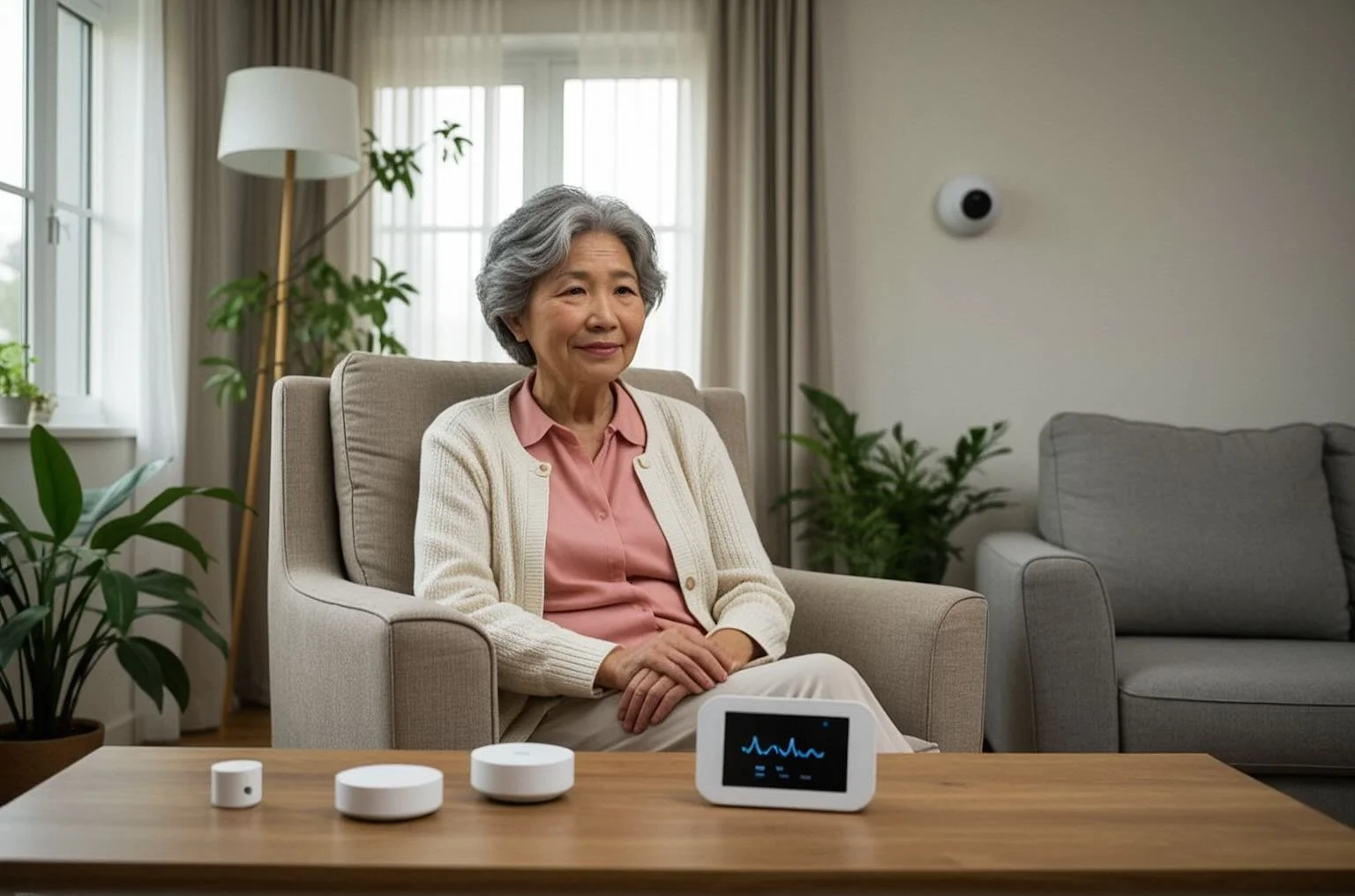
For many adult children, the hardest part of caregiving is not the tasks themselves. It is the uncertainty. You are trying to work, manage your own household, and stay present for someone you love, all while wondering if they got out of bed, moved around the house normally, or spent an unusual amount of time in the bathroom. Good monitoring should reduce that uncertainty without making home feel like a hospital.
What elder care sensors actually do
Elder care sensors are small devices placed around the home to detect patterns of activity. Depending on the system, they may track motion in key rooms, door openings, bed occupancy, or signs that a normal routine has changed. The goal is not constant surveillance. The goal is to notice meaningful shifts.
That difference matters. A camera may show raw footage, but it also asks families to monitor more than they want to see and many older adults simply do not want to live on camera. Wearables can help in some cases, but they rely on a person remembering to put them on, charge them, and keep them nearby. Passive sensors work in the background. When they are designed well, they offer a clearer picture of daily wellbeing with less effort and far less intrusion.
A simple example helps. If your dad usually starts moving around the kitchen by 7 a.m. and one morning there is no activity, that may prompt a check-in. If bathroom visits suddenly increase overnight for several days, that could suggest a health change worth discussing. If movement steadily drops over two weeks, it may point to fatigue, pain, depression, or recovery trouble. One isolated event may mean nothing. A pattern is what gives the information value.
Why families are turning to elder care sensors
Most families are not looking for more data. They are looking for reassurance they can trust. That is why elder care sensors have become more appealing to caregivers who feel stretched thin and do not want another complicated system to manage.
The biggest benefit is early visibility. Small changes often show up in routine before they become obvious in conversation. A parent may say everything is normal because they do not want to worry anyone, or because they have not noticed the gradual shift themselves. Sensors can help surface those changes sooner, while there is still time to respond calmly.
There is also a dignity piece that should not be overlooked. Many older adults want support, but not supervision. They want to stay in their own home without feeling watched. Passive monitoring respects that boundary better than cameras or microphones. It offers oversight without turning private moments into footage or audio clips.
For long-distance caregivers, this can be especially meaningful. If you cannot stop by every day, uncertainty tends to fill the gaps. A smart sensor system gives you context. Not every alert means an emergency, but knowing whether routines are stable can take some of the emotional weight off your shoulders.
The best elder care sensors focus on patterns, not just events
This is where systems begin to separate from one another. Basic sensors can tell you that motion happened in a room. More advanced systems can understand whether the overall pattern looks normal for that person.
That matters because caregiving decisions are rarely based on one moment. They are based on change over time. A single missed kitchen visit may be harmless. Three mornings in a row is a different story. A front door opening once in the afternoon is expected. Repeated overnight exits may not be.
Behavioral context turns sensor signals into something useful. Instead of making family members interpret raw activity logs on their own, the better approach is to translate household activity into simple, meaningful insights. That might mean an alert when there is no morning movement, or a summary showing that sleep appears more disrupted than usual.
This is one reason families often prefer AI-supported monitoring over older alert systems. It is not just about collecting signals. It is about helping caregivers understand what those signals may mean in everyday life.
Privacy is not a feature - it is the point
If you are considering monitoring for a parent, privacy should be part of the decision from the start. Many families reject cameras immediately, and with good reason. Even if the goal is safety, cameras can feel invasive in bedrooms, bathrooms, and the ordinary private rhythms of home.
The same is true for microphones. Most people do not want conversations captured, stored, or reviewed. And many seniors will tolerate those tools only reluctantly, which can create tension right when families are trying to build trust.
That is why discreet motion-based systems are often a better fit. They can show whether someone is active, resting, or following their normal routine without recording what they look like, what they are doing in detail, or what they are saying. The technology fades into the background, which is often exactly what older adults want.
Privacy also affects adoption. A solution only works if your loved one agrees to live with it. The less intrusive it feels, the more likely they are to accept it as support rather than surveillance.
What to look for before you choose a system
Not all monitoring setups are equally helpful. Some give families a flood of notifications without enough context. Others are so basic that they do little beyond confirming motion in a room. The best systems strike a balance between visibility and simplicity.
Look for a system that can learn routines over time rather than forcing you to define every rule manually. Daily life is not perfectly scheduled, and a rigid setup can produce too many false alarms. You also want alerts to be understandable at a glance. If you are juggling meetings, errands, and your own family, you should not need to study charts just to know whether something needs attention.
Ease of installation matters too. Complex hardware can delay adoption and create frustration before the system even starts helping. Families usually do best with sensors that are quick to place, easy to maintain, and designed for ordinary homes rather than clinical settings.
It is also worth thinking about who receives the information. Some systems are built for professional staff. Others are built for family caregivers who simply want timely updates on their phones. That difference shapes the whole experience.
Where sensor monitoring helps most
Elder care sensors are especially helpful when the concern is not one dramatic event but an accumulation of small risks. That includes falls, wandering, disrupted sleep, mobility decline, recovery after hospitalization, or signs that someone is becoming less active and less steady at home.
They can also support families dealing with conditions that affect movement or routine. Parkinson's disease, for example, may change gait, nighttime bathroom use, or general activity levels. Recovery from illness or injury may bring slower mornings and more time resting. Even without a formal diagnosis, subtle changes in behavior can be the first sign that extra support is needed.
For many families, the value is not that sensors replace care. It is that they help care happen sooner and with less guesswork. A son who sees a meaningful change can call that day instead of waiting until the weekend. A daughter who notices repeated overnight disruptions can bring it up at the next doctor visit with something more concrete than a vague feeling.
StackCare was built around that everyday reality: families do not need more surveillance. They need dependable insight that helps them protect a loved one's independence while feeling less alone in the process.
The trade-offs are real, and that is okay
No technology removes every caregiving challenge. Sensors do not diagnose medical conditions, and they cannot replace human judgment or regular contact. They also work best when the home setup matches the person's habits and needs. If someone spends long periods sitting very still, or lives with others, interpreting activity may become more nuanced.
Still, the right system can shrink the space between worry and action. It can tell you when a routine looks off, when a pattern changes, and when it may be time to check in. That is often enough to turn late-night uncertainty into a plan.
If you are trying to help a parent stay safe at home, start with a simple question: what would actually give your family peace of mind without taking away theirs? The best answer is usually not more watching. It is better understanding.