
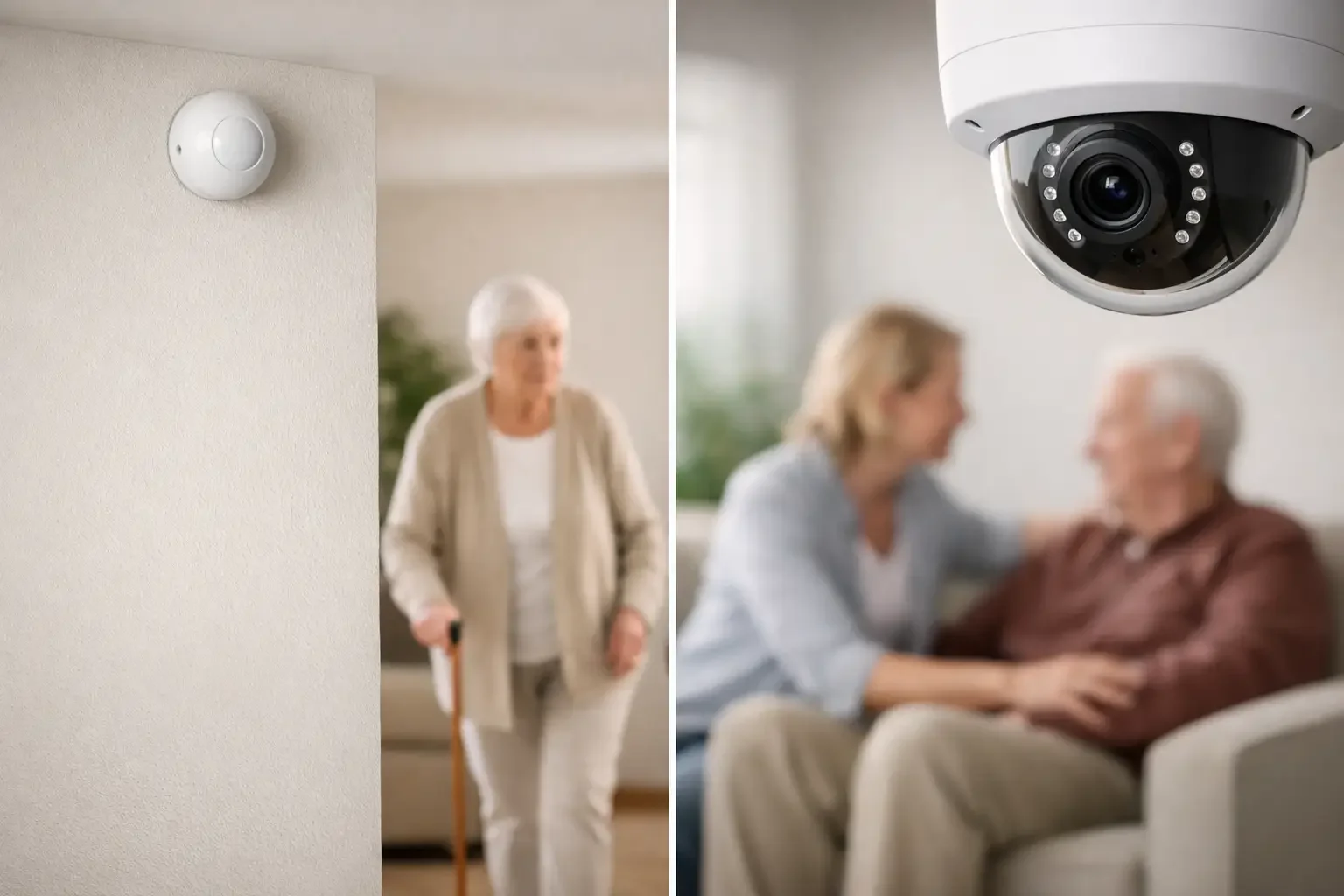
For many families, this decision is not really about technology. It is about balancing safety with dignity. You want more visibility into your loved one’s well-being, but you do not want their home to feel like a surveillance zone.
Elder sensors vs cameras: the real difference
At a basic level, cameras show you what happened. Sensors tell you that something happened.
That may sound like a small distinction, but in day-to-day caregiving, it changes everything. Cameras capture video footage in specific rooms. Depending on the setup, they may also record audio. Sensors, by contrast, usually detect motion, door activity, room transitions, or patterns like bathroom visits and overnight movement without capturing images or conversations.
For some families, cameras feel reassuring at first because video seems more direct. If you can see the room, it feels like you know what is going on. But that clarity often comes with trade-offs that become harder to ignore over time.
Sensors are less about watching and more about understanding routines. Instead of asking a daughter to scan footage, a sensor-based system can identify that Dad did not enter the kitchen this morning, spent far longer in the bathroom than usual, or showed unusually low activity all afternoon. That is a different kind of visibility. It is often more useful because it focuses on change.
Why cameras can feel reassuring and still fall short
There are situations where cameras have a place. If a family is trying to confirm frequent falls in a shared living area, or if a loved one agrees to visible monitoring in a narrow part of the home, a camera may offer helpful context. Some caregivers also like being able to check in visually when they cannot visit in person.
But cameras create their own burden. Someone usually has to review footage, respond to notifications, or decide whether what they are seeing is actually a problem. That can turn caregiving into another screen-based responsibility in an already overloaded day.
There is also the human side. Many older adults do not want cameras in private spaces, and understandably so. Even when cameras are limited to common areas, they can still make a home feel less like home. A parent may tolerate them for the family’s sake while quietly feeling embarrassed, exposed, or less independent.
That discomfort matters. Monitoring only works if the older adult accepts it enough to live naturally in the space. If they start changing behavior because they feel watched, the system may become less helpful, not more.
Why sensor-based monitoring often fits aging at home better
Aging in place works best when support is present but not disruptive. That is where sensors often have the advantage.
A well-designed sensor system can sit in the background and learn daily rhythms. It can notice whether someone got up at the usual time, moved through the home normally, opened the refrigerator, or made repeated nighttime bathroom trips. It can also flag meaningful changes, such as less activity over several days or unusual motion patterns that may suggest weakness, illness, or recovery trouble.
This kind of monitoring is especially valuable for families who live far away or who cannot call and visit constantly. They do not need endless raw data. They need to know when something is off.
That is why behavioral insights matter more than simple motion detection. A pile of activity logs is not helpful if a caregiver still has to interpret everything themselves. What reduces stress is getting a clear alert when a routine changes in a way that deserves attention.
For families who want oversight without intrusion, this approach often feels like the best middle ground. It supports safety while protecting privacy.
Privacy is not a small detail
In elder care, privacy is often treated like a secondary preference. It is not. Privacy is closely tied to dignity, trust, and the older adult’s willingness to accept help.
Most seniors want to stay independent for as long as possible. That does not just mean staying out of a facility. It means being able to move through their own home without feeling observed every minute. Cameras can undermine that feeling quickly, especially in bedrooms, hallways near bathrooms, or places where someone relaxes, changes clothes, or has personal moments.
Sensors are not invisible in a moral sense. Families should still talk openly about what is being monitored and why. But there is a major difference between knowing motion patterns are being tracked and knowing a camera could capture you every time you shuffle to the bathroom in your robe.
For many families, that difference is the deciding factor.
What families actually need from monitoring
Most adult children are not trying to create a high-tech command center. They are trying to stop guessing.
They want to know if their mom is following her normal routine. They want to know if their dad, who is recovering from a hospital stay, is moving less than expected. They want to know if a parent with Parkinson’s is making more frequent nighttime trips or spending too long in one room. And they want to know this without calling five times a day and without asking a loved one to wear something they will probably forget to charge.
That is why the most helpful systems do not just collect information. They turn information into something usable. Smart alerts, simple daily summaries, and pattern-based insights help families respond earlier and with more confidence.
This is where companies like StackCare have taken a different approach from traditional monitoring. Instead of asking families to watch, interpret, and worry, the goal is to deliver clear signals about well-being while keeping the home private and calm.
When cameras may still make sense
Even if sensors are the better fit for many households, there are cases where cameras are still worth considering.
If a loved one has advanced cognitive decline and a physician or care team recommends visual monitoring in limited areas, a camera may serve a specific purpose. The same can be true in a home with paid caregivers, where families want accountability in entryways or common spaces. Some households also choose a hybrid approach, using sensors throughout the home and a camera only at the front door.
The key is being honest about the goal. If the goal is ongoing awareness of daily well-being, cameras are often too invasive and too manual. If the goal is to visually verify a very specific concern in a very specific place, they may be appropriate.
It depends on the person, the health condition, the home layout, and the family’s comfort level. There is no single right answer for every situation.
How to choose between elder sensors and cameras
Start with the problem you are trying to solve. If your biggest concern is whether your loved one is maintaining normal routines, getting up, moving around, eating, and sleeping as expected, sensors are usually the better tool. If you are trying to monitor one narrow activity that truly requires visual confirmation, a camera may have a role.
Then think about consent. What will your parent actually accept? A technically impressive system is not useful if it creates conflict or gets unplugged after a week. Many older adults are much more comfortable with passive sensors because they feel less intrusive.
You should also think about who will manage the information. If alerts require you to constantly open an app, review clips, and decide what matters, the system may add work instead of reducing it. A better setup gives you meaningful updates without demanding your attention every hour.
Finally, ask what preserves independence. The best monitoring should support a loved one’s ability to live at home on their own terms, not make home feel smaller.
Choosing care technology can stir up guilt, second-guessing, and family disagreements. That is normal. Most people are doing the best they can in a situation that has no perfect answers. If you keep coming back to privacy, dignity, and useful insight over constant watching, you are probably asking the right questions.