
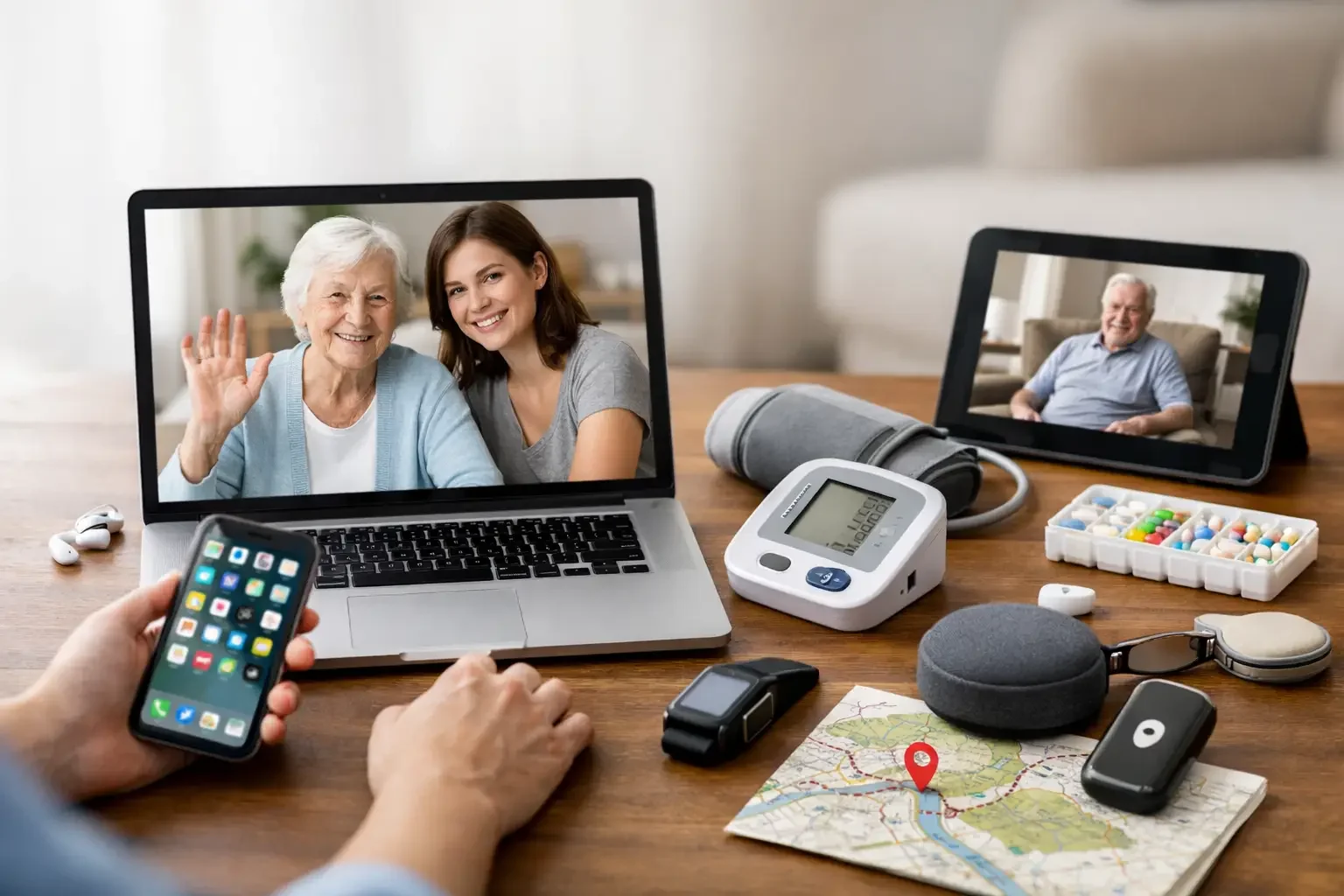
The challenge is not finding more technology. It is finding the right kind. Most family caregivers are not looking for another app to manage or a flood of raw data to interpret after a full workday. They want a clearer picture of how their parent is doing, faster notice when something changes, and support that still respects independence.
What the best tools for long distance caregiving actually do
A useful caregiving tool should reduce uncertainty, not create more of it. That sounds obvious, but many products promise peace of mind while adding passwords, dashboards, devices to charge, and alerts that are too frequent to trust. The best options tend to do one of three things well: they improve visibility, simplify coordination, or make communication easier.
Most families need some combination of all three. If your parent is fairly independent but you worry about subtle changes, visibility matters most. If several siblings are involved and no one knows who is handling appointments or refills, coordination tools become essential. If your loved one is lonely, forgetful, or hard to reach, communication support may be the biggest gap.
That is why there is no single perfect setup. The right mix depends on distance, health needs, personality, and how much help your loved one is willing to accept.
1. Passive in-home monitoring for day-to-day reassurance
For many long-distance caregivers, this is the most meaningful category because it fills the gap between silence and crisis. Passive in-home monitoring uses discreet sensors to track patterns such as movement, sleep, bathroom activity, and time spent in key areas of the home. Instead of asking you to watch a video feed or check a dashboard all day, the system looks for changes and sends alerts when something seems off.
This matters because serious problems are not always dramatic. A parent may not fall, but they may start getting up far more often at night, moving less during the day, or spending an unusual amount of time in the bathroom. Those shifts can point to illness, medication issues, mobility decline, or recovery problems before anyone says a word.
Privacy is the trade-off families should think about carefully. Many people understandably reject cameras and microphones in private spaces. A passive monitoring approach can be a better fit because it offers insight without recording conversations or video. That balance is a big reason some families choose solutions like StackCare, especially when the goal is to preserve dignity while still getting timely alerts.
2. Medication management tools that reduce missed doses
Medication is one of the first things to get complicated from a distance. Maybe your parent remembers morning pills but forgets the evening dose. Maybe prescriptions change after a hospital visit and no one is sure what is current. Maybe a sibling assumes someone else checked in.
A good medication tool can help with reminders, refill tracking, and adherence. For some families, a simple phone reminder is enough. For others, an automated pill dispenser with scheduled prompts makes more sense. The more complex the regimen, the more helpful it is to have a system that confirms whether medication was actually taken, not just whether a reminder was sent.
Still, it depends on your loved one’s habits. If they are resistant to new devices or have trouble hearing prompts, the fanciest dispenser may sit unused. In those cases, pairing a simpler reminder system with regular family oversight can work better than buying more hardware.
3. Shared care coordination apps for families juggling everything
Long-distance caregiving often breaks down over communication, not intention. One sibling thinks Mom’s groceries were handled. Another assumes Dad’s follow-up appointment is next week. Everyone cares, but tasks live in text threads, sticky notes, and half-remembered phone calls.
A shared care coordination app creates one place for schedules, updates, tasks, medications, and contacts. This can lower stress quickly, especially in families where several people are trying to help from different cities. It also helps when a home care aide, neighbor, or local friend is part of the support circle.
The catch is adoption. These tools only work if people use them consistently. If your family already struggles to reply to a group text, choose the simplest platform possible. A lighter system that everyone actually checks is far more useful than a feature-rich one that gets abandoned after a week.
4. Video calling tools for face-to-face check-ins
Video calls are still valuable, even though they are not enough on their own. Seeing your parent’s face can tell you a lot that a phone call cannot. You might notice fatigue, confusion, changes in mobility, or whether they seem less steady than usual. For your loved one, regular video calls can also reduce isolation and create a stronger routine.
But video has limits. It only shows what happens during that short window, and some older adults do not answer reliably or feel comfortable with the technology. Others may tidy up concerns before the call and say everything is fine because they do not want to worry you.
That does not make video unhelpful. It just means it works best as part of a broader setup rather than your only source of reassurance.
5. Emergency alert systems for urgent situations
If a parent lives alone, an emergency response tool deserves serious consideration. These systems can help after a fall, sudden illness, or moment of distress by connecting the person to emergency support quickly. For families, that can ease the fear of what happens if something goes wrong when no one is nearby.
The main issue is that many systems rely on the older adult pressing a button or wearing a device consistently. Some people forget. Some stop wearing it because it feels stigmatizing or uncomfortable. Others cannot reach it in an actual emergency.
That is why emergency tools are important but often incomplete by themselves. They are strongest when paired with something that also offers everyday visibility, not just crisis response.
6. Smart home safety devices that solve practical risks
Not every helpful tool needs to be labeled as caregiving technology. Sometimes the best support comes from simple smart home devices that reduce everyday risk. Smart locks can help caregivers or aides enter without hiding keys. Video doorbells can confirm arrivals and deliveries. Smart lights can make nighttime movement safer. Stove shut-off devices can reduce fire risk for someone with memory issues or distraction.
These tools are especially useful when your loved one wants to stay independent but could benefit from a few environmental safeguards. They also tend to feel less intrusive than systems that are overtly medical.
Still, they can create a patchwork problem. If every issue gets solved with a different device and app, caregiving starts to feel like managing a small IT department. Simplicity matters. It is often better to choose a few high-impact devices than stack five marginal ones.
7. Transportation and delivery apps that support daily life
Long-distance caregiving is not only about health and safety. It is also about whether daily life still works. Can your parent get groceries if they no longer drive? Can they get to appointments? Can they receive meals or prescriptions without asking for help every time?
Transportation and delivery services can quietly support independence in a big way. They reduce the number of emergencies that are not really emergencies, just logistics problems that land on your phone because you are the nearest family decision-maker, even from 700 miles away.
These tools are most effective when your loved one is comfortable using a phone or when a caregiver can help schedule services. If technology use is limited, arranging recurring support may be better than depending on on-demand apps.
How to choose the right caregiving tools without overcomplicating things
Start with the moments that create the most worry. If you are losing sleep over what happens between phone calls, prioritize visibility into daily routines. If family communication is the messiest part, start with coordination. If missed medications or falls are the real risk, address those first.
It also helps to think about what your loved one will realistically accept. A tool is only useful if it fits their personality and daily habits. Many older adults are open to support, but they do not want to feel watched, managed, or infantilized. Privacy and dignity are not side issues. They often determine whether a solution lasts.
The best setup is usually not the most high-tech one. It is the one that gives you meaningful information, reduces unnecessary check-ins, and helps your parent stay at home with confidence.
If you are trying to care well from far away, you do not need perfect control. You need clearer signals, better coordination, and a way to respond sooner when something changes. Often, that is enough to replace constant worry with something more sustainable: trust.