
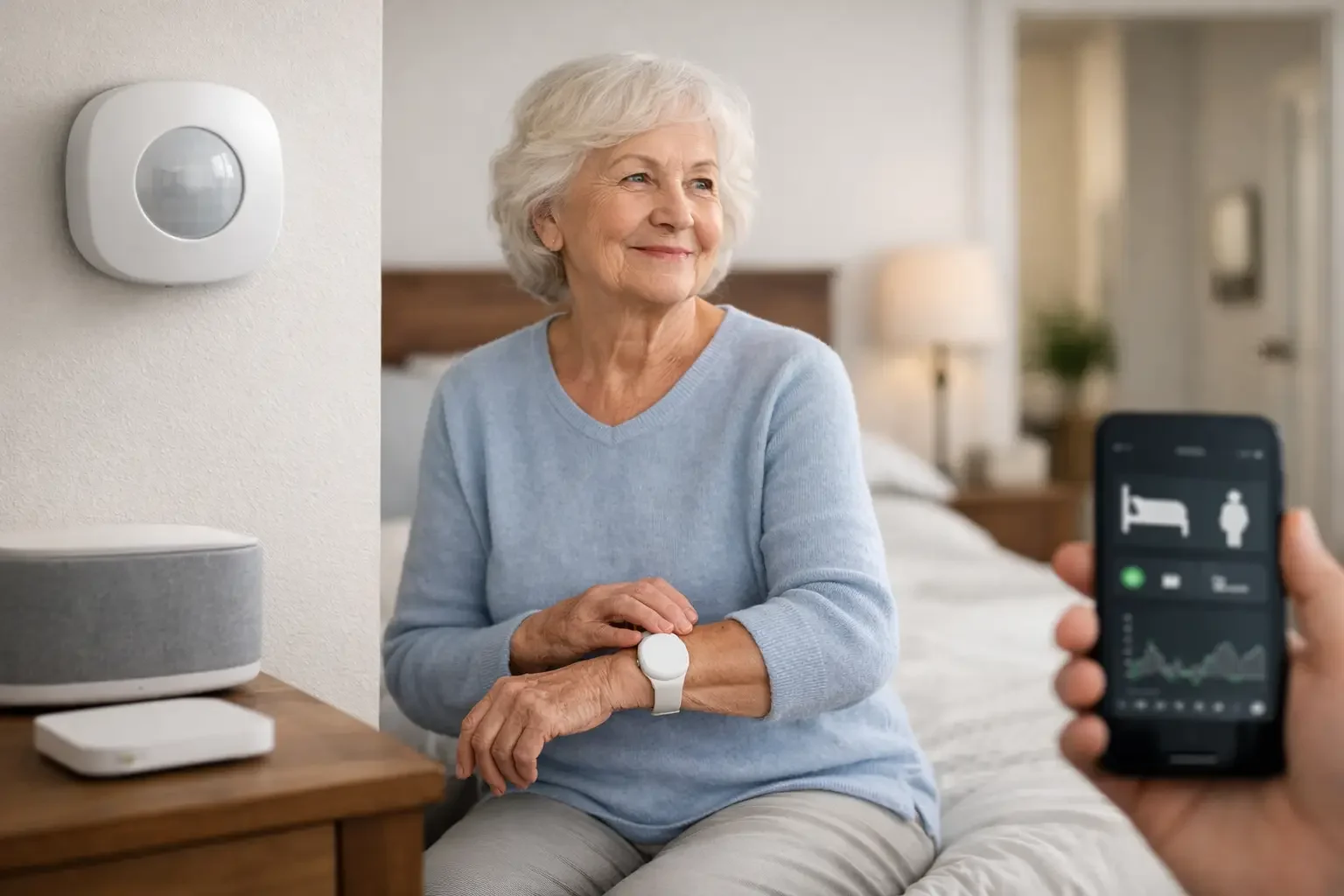
You do not need a live video feed of your parent’s kitchen to know something is wrong. What most families actually need is simpler and more humane: a way to tell whether Mom got out of bed, whether Dad is moving around less than usual, or whether a bathroom trip in the middle of the night has suddenly become much more frequent. That is why senior monitoring without cameras has become such a practical option for families trying to support an older loved one living alone.
For many adult children, the problem is not a lack of love or attention. It is the impossible math of caregiving. You are juggling work, your own household, maybe kids, and the constant low-level worry that something could change between phone calls. A parent may insist they are fine, even when their routine is shifting in ways that matter. At the same time, putting cameras inside someone’s home can feel like crossing a line. Safety matters, but so do dignity, trust, and independence.
Why families are looking for senior monitoring without cameras
Most people do not want their private moments turned into footage. That discomfort is not just about modesty. It is about autonomy. Older adults who live alone often want support, but they do not want to feel watched while making coffee, getting dressed, or walking to the bathroom at 2 a.m.
This is where camera-free monitoring makes sense. Instead of recording images or sound, these systems use discreet [in-home sensors](https://stack.care/blog/2026/4/28/how-in-home-monitoring-for-seniors-helps) to notice movement patterns and daily activity. The goal is not surveillance. The goal is awareness.
That difference matters more than it may seem. A camera tells you what happened in a specific moment if someone checks the feed. A well-designed passive monitoring system helps you understand whether a routine is changing over time and whether that change may need attention. For caregivers, that often provides more useful reassurance with far less intrusion.
What camera-free monitoring actually tracks
When people first hear about passive monitoring, they sometimes assume it must be vague or limited. In reality, the most helpful systems can paint a very clear picture of day-to-day wellbeing without collecting sensitive video or audio.
A sensor-based setup can show whether someone is getting up at their normal time, moving between rooms as expected, sleeping restlessly, or spending longer than usual in the bathroom. It can also flag when movement drops off unexpectedly or when a routine suddenly shifts. Those details may sound small, but they are often the first signs that something is off.
For example, less kitchen activity might suggest a parent is skipping meals. More nighttime wandering could point to poor sleep, medication issues, or growing confusion. A sharp decline in overall movement might signal illness, pain, or recovery trouble after a fall. Families do not always need to see these moments. They need to know they are happening.
The privacy trade-off is real, and families feel it
Many caregiving decisions come with some degree of compromise. Monitoring is one of them. Cameras can provide visual confirmation, which may seem comforting at first. But they can also create a new kind of stress. Seniors may feel exposed in their own homes, and family members may feel uneasy about having access to intimate parts of a loved one’s daily life.
That tension often shows up in the rooms where cameras are needed most. A hallway camera might feel tolerable. A bedroom or bathroom camera usually does not. Yet those are exactly the spaces where changes in sleep, mobility, and bathroom patterns can reveal health concerns early.
Senior monitoring without cameras offers a more balanced approach. It gives families insight into what is changing while allowing the older adult to keep their private spaces private. For many households, that makes it easier to get everyone on board.
How passive monitoring helps caregivers respond sooner
The hardest part of supporting a parent from a distance is not always the emergency. It is the uncertainty before one. You wonder whether the extra fatigue on the phone was nothing or the start of something. You wonder if fewer calls mean they are busy or withdrawing. You wonder whether you are overreacting.
Passive monitoring reduces that uncertainty by turning daily patterns into useful signals. Instead of waiting for a crisis, you can be alerted when routines change in meaningful ways. If your mom usually starts moving around by 7:30 and one morning there is no activity, that may prompt a quick check-in. If your dad has been visiting the bathroom far more often over several nights, that may suggest a health issue worth discussing.
This kind of visibility does not replace care. It supports better decisions. Families can respond earlier, ask better questions, and avoid the cycle of guessing, worrying, and hoping for the best.
Not all monitoring systems are equally helpful
Some systems give families raw data and expect them to make sense of it. That sounds good in theory, but in practice, most caregivers do not have time to study activity charts between meetings or while managing school pickup. What they want is clarity.
The best systems do more than report motion. They look at patterns, learn what is typical in the home, and notify caregivers when something changes in a way that may matter. That is a very different experience from simply watching for a sensor to trip.
This is where [behavioral analytics](https://stack.care/inside-the-app) can make a real difference. Instead of drowning families in information, a smarter system translates activity into understandable updates: normal overnight movement, lower-than-usual daytime activity, missed morning routine, unusual bathroom frequency. That kind of insight respects the caregiver’s time while still delivering meaningful oversight.
When senior monitoring without cameras is a strong fit
T
his approach is especially helpful for older adults who value their independence and do not want to wear a device or remember to press a button. It also fits families who live far away, work full time, or simply cannot rely on constant phone contact to understand how things are going.
It can be useful after a hospitalization, during recovery from an injury, or when mobility is changing gradually and no one is quite sure how much support is now needed. It may also help families caring for someone with Parkinson’s disease, mild cognitive decline, or general frailty, where subtle routine changes can be meaningful before a major event occurs.
That said, it is not a perfect solution for every situation. If a loved one needs hands-on medical supervision, frequent physical assistance, or direct intervention throughout the day, passive monitoring alone may not be enough. It works best as part of a broader support plan, especially when the goal is helping someone remain safely at home for as long as possible.
What families should look for in a camera-free system
A good system should be easy for the older adult to live with and easy for the family to understand. If it requires constant charging, complicated setup, or a lot of manual review, it may add more stress than relief.
Look for a solution that is truly passive, sends timely alerts, and gives clear summaries rather than endless data points. Privacy should be built into the design, not treated like an afterthought. And the information should be useful in everyday caregiving terms, not buried in technical language.
This is why many families are moving toward AI-supported sensor systems such as StackCare. When the technology is designed around routine changes and caregiver alerts, it becomes less about gadgets and more about confidence. You are not checking in because you are afraid every minute. You are checking in because you have a clearer sense of when something actually needs your attention.
Safety and dignity do not have to compete
Families often feel they have to choose between protecting a parent and respecting their privacy. In reality, the best care solutions do both. A senior who feels trusted is often more open to support. A family that gets simple, reliable insight is less likely to rely on repeated calls, constant worry, or intrusive surveillance.
That is what makes camera-free monitoring so valuable. It meets a real caregiving need without turning the home into a place of observation. It helps preserve normal life, which is exactly what most older adults want.
If you are trying to keep a parent safe at home, start with the question that matters most: what kind of support would help them feel protected without feeling watched? Often, that answer leads to a better kind of monitoring and a little more peace for everyone involved.