
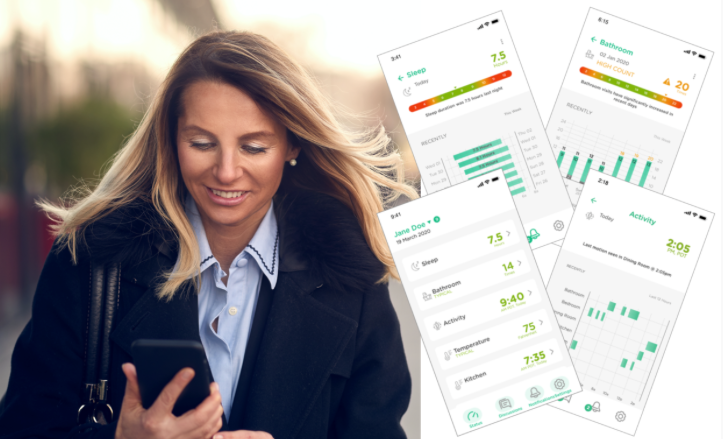
For many families, the hardest part is not managing a clear emergency. It’s living in the gray area between “everything is probably fine” and “something feels off.” A parent may insist they’re doing well, and they may be right. But if they live alone, recovering from an illness, dealing with mobility changes, or simply aging more slowly than they admit, those daily unknowns can weigh heavily on everyone involved.
That’s where wellness alerts can make a meaningful difference. Not by replacing human care, and not by turning a home into a surveillance zone, but by giving families a simple way to notice whether a loved one’s day looks normal.
What daily wellness alerts for seniors actually tell you
At their best, daily wellness alerts for seniors do something very simple. They turn ordinary activity into useful reassurance.
Instead of requiring a parent to wear a device, press a button, or remember to check in, a passive monitoring system looks at patterns in the home. Was there normal movement in the morning? Did the kitchen get used around the usual time? Is bedtime activity consistent with what has been typical? If something changes, the system can send an alert or summary to a family caregiver.
That distinction matters. Families usually do not need more raw data. They need to know whether the day unfolded in a familiar way or whether there was a change worth paying attention to.
For example, a useful alert might indicate that your mom has not started moving around by her usual time, or that your dad’s nighttime bathroom activity has increased over several days. Neither update automatically means there is a crisis. But both can help you ask better questions sooner.
Why simple alerts matter more than constant check-ins
Many adult children try to manage concern through frequent calls and texts. That works up to a point, but it often creates a quiet kind of strain. The caregiver feels responsible for watching closely. The older adult may feel watched.
Daily alerts shift that dynamic. Instead of interrupting a loved one’s day just to confirm that nothing is wrong, you get a clearer sense of whether their normal routine is happening. That means your calls can become more meaningful and less performative.
This also helps long-distance caregivers. If you live in another city or state, it is hard to judge what “fine” means over the phone. A parent may minimize symptoms, forget details, or simply not want to worry you. A daily pattern-based update gives context that a quick conversation often cannot.
There is also an emotional benefit that families rarely talk about enough. When you are not carrying the whole burden of noticing every possible problem yourself, your relationship has more room to feel like family again.
The difference between helpful monitoring and invasive monitoring
Not every monitoring tool feels the same inside a home. This is one of the biggest reasons families hesitate.
Cameras may offer visibility, but many seniors find them uncomfortable, especially in private spaces. Wearables can be useful in some situations, yet they depend on consistent charging and daily compliance. Emergency buttons help during acute events, but only if the person is able and willing to press them.
That is why passive, privacy-first monitoring often feels like a better fit for aging in place. Motion sensors and behavioral analytics can observe routines without recording conversations or video. The goal is not to watch a person. The goal is to understand whether their day still looks like their day.
That approach respects dignity in a very practical way. It allows an older adult to move through the home naturally while still giving family members insight when a pattern changes.
Of course, there are trade-offs. Passive monitoring can reveal that something is different, but it may not always explain why. A later wake-up time could mean poor sleep, a minor illness, a medication issue, or simply a lazy morning. Families still need judgment, communication, and context. Alerts are most valuable when they support care decisions, not when they are treated as the whole picture.
What to look for in daily wellness alerts for seniors
The best systems are easy to understand when you are tired, busy, and already juggling too much. That usually means concise notifications, clear summaries, and alerts that focus on meaningful changes rather than every small movement.
Look for a system that learns routines over time instead of forcing every household into the same standard. One older adult may be up at 5:30 a.m. every day. Another may not leave the bedroom until 9:00. A smart alert should recognize the difference.
It also helps if notifications are framed in plain language. Families should not need to interpret charts all day. “No morning activity detected” is more useful in the moment than a complex dashboard full of time stamps.
Privacy should be non-negotiable. If your loved one would reject cameras or resent anything that feels intrusive, a sensor-based approach is often easier to accept and easier to live with long term.
Finally, consider whether the system supports both daily reassurance and faster intervention. Some caregivers mainly want a reliable summary of normal routines. Others need immediate alerts because a parent has fall risk, nighttime wandering, Parkinson’s symptoms, or a recent hospital discharge. The right fit depends on what your family is managing now, not just what sounds good in theory.
When wellness alerts are especially useful
These tools can help any family supporting an older adult who lives alone, but they become especially valuable during periods of change.
After a hospitalization, families often worry about setbacks that happen quietly at home. A reduction in movement, changes in sleep, or unusual bathroom patterns can provide early signs that recovery is not going as expected.
The same is true for progressive conditions. If your loved one has mobility limitations, mild cognitive decline, or a condition that affects routines gradually, daily alerts can surface small shifts that are easy to miss during weekly visits or occasional calls.
They can also help when there is no diagnosis at all, only a growing sense that managing alone is becoming harder. In these situations, the question is rarely “Is there one dramatic event?” More often, it is “Are the little signs adding up?”
That is where pattern-based monitoring earns its value. It gives families a clearer baseline, so changes stand out earlier.
How families use alerts in real life
Most caregivers are not looking for one more app to monitor obsessively. They want relief from wondering.
A daily summary might reassure you that your mother got up on time, moved through the house normally, and settled in for the evening as expected. You can go to bed without replaying the same worry loop.
An alert might tell you that your father has had much less activity than usual over the past day. That prompts a call. Maybe he is coming down with something. Maybe his arthritis is flaring. Maybe he needs help before the issue becomes bigger.
This is also where family coordination gets easier. Instead of vague concerns like “I have a feeling Mom’s off,” relatives can respond to something more concrete. One sibling can call, another can stop by, and everyone starts from the same information.
Companies like StackCare are built around this reality. The goal is not to flood families with data. It is to give them a trustworthy heads-up when daily life no longer looks routine.
A better way to support independence
There is a common misunderstanding that more monitoring automatically means less independence. In practice, the opposite can be true when the technology is respectful.
Older adults often stay at home longer and more comfortably when families feel confident that major changes will not go unnoticed. A good alert system can reduce pressure for unnecessary check-ins, premature moves, or more intrusive supervision.
That matters because independence is not just about living alone. It is about preserving choice, privacy, and the feeling of being trusted in your own home.
For caregivers, that creates a healthier role too. You are still involved. You are still attentive. But you are no longer forced to choose between constant vigilance and crossed fingers.
If you are caring for someone who values privacy and wants to remain at home, daily wellness alerts may not solve every challenge. What they can do is make the day-to-day more visible, the unknowns less heavy, and the next conversation with your loved one a little calmer.